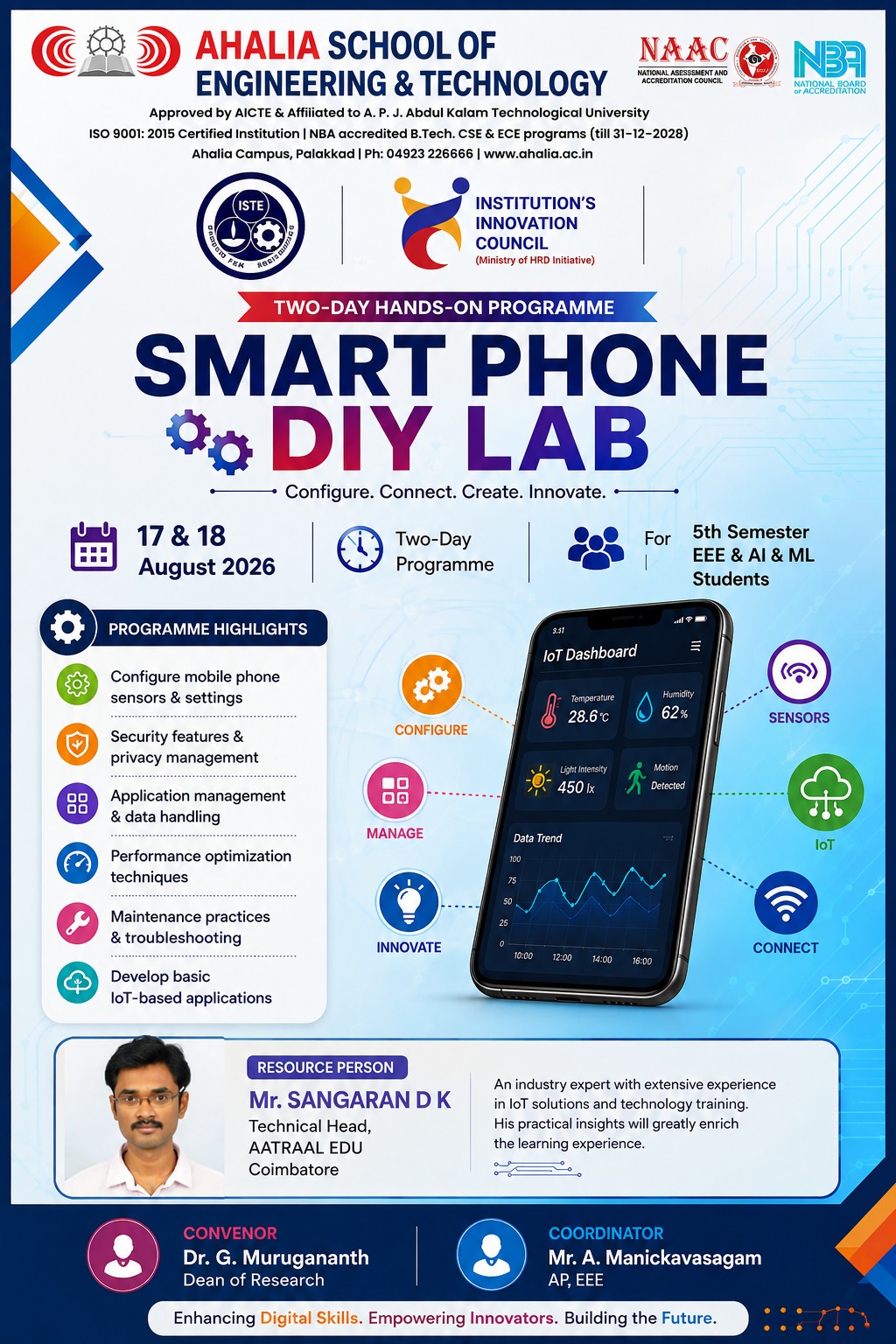

A practical technology-enrichment programme for 5th Semester EEE & AI & ML students, focused on smartphone sensors, system configuration, security, application management, data handling, performance optimisation, maintenance, and basic IoT applications.
- Programme at a Glance
Programme
SMART PHONE DIY LAB
Duration
Two Days – 17 & 18 August 2026
Organizing Department
Department of Electrical and Electronics Engineering
Participants
5th Semester EEE & AI & ML Students
Resource Person
Mr. Sangaran D K, Technical Head, AATRAAL EDU, Coimbatore
Convenor
Dr. G. Murugananth, Dean of Research
Coordinator
Mr. A. Manickavasagam, AP, EEE
Technical Support
Mr. Deepak Mathew, Teaching Assistant; Mr. Dinesh K, Senior Lab Instructor
Venue
AI&ML Lab, Main Building, ASET, Ahalia Campus, Pudussery East, Palakkad, Kerala - Background and Purpose
The Department of Electrical and Electronics Engineering organised the two-day hands-on programme “SMART PHONE DIY LAB” on 17 and 18 August 2026 to extend classroom learning into practical digital and IoT-oriented skills. The programme was designed to help students understand smartphone hardware and software features through guided experimentation and configuration activities. The programme placed particular emphasis on configuring mobile-phone sensors, understanding essential system settings and security features, managing applications and data, improving device performance, and adopting appropriate maintenance practices. The sessions also introduced students to the use of smartphone capabilities as building blocks for basic IoT-based applications. - Objectives
- Familiarise students with smartphone sensors and their practical configuration.
- Develop hands-on competence in system settings, security, privacy and device management. Report on SMART PHONE DIY LAB | 17–18 August 2026
- Strengthen skills in application management and responsible data handling.
- Introduce practical approaches for performance optimisation, maintenance and troubleshooting.
- Demonstrate how smartphone sensors and connectivity features can support basic IoT applications.
- Enhance digital confidence, troubleshooting ability and industry-oriented technical competence.
- Resource Person
Mr. Sangaran D K, Technical Head, AATRAAL EDU, Coimbatore, served as the Resource Person. His industry-oriented experience and practical understanding of technology applications added significant value to the programme. The sessions encouraged active participation, experimentation and problem-solving rather than purely theoretical learning. - Programme Proceedings
Day 1 – 17 August 2026
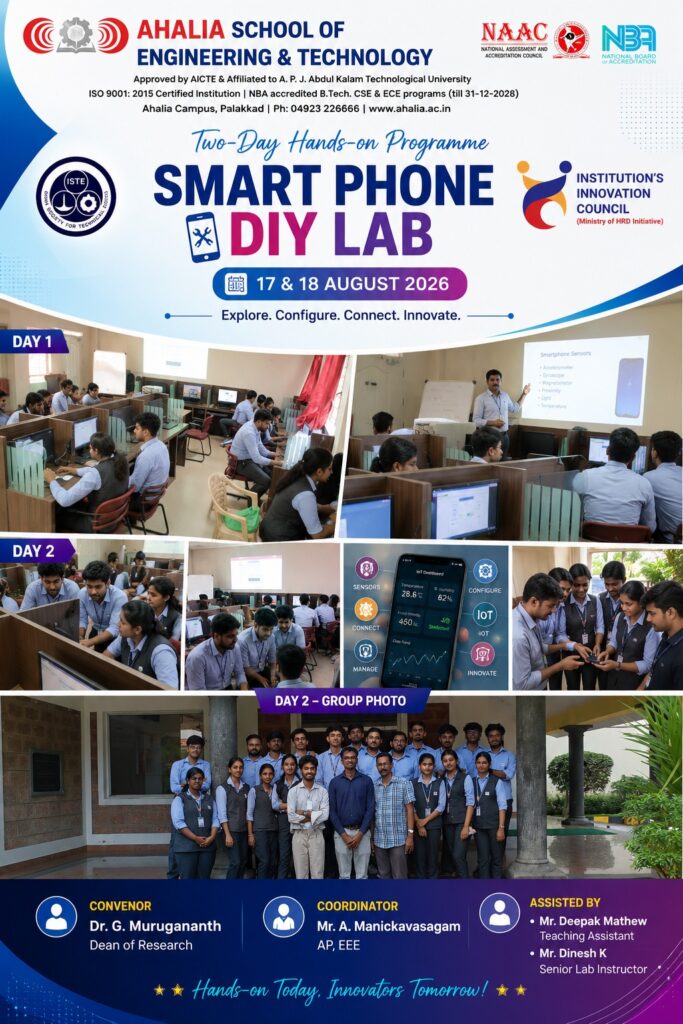
The first day focused on establishing a practical foundation for smartphone-based technical work. Students were introduced to the major capabilities of contemporary smartphones, with emphasis on sensor configuration, system settings, security and privacy controls, application management and data handling. Demonstrations were followed by guided hands on activities that enabled students to explore settings and observe the behaviour of different smartphone functions. The practical orientation encouraged students to work directly with devices, identify configuration options, understand their purpose, and develop confidence in systematic troubleshooting. The first-day activities established the foundation for the more application-oriented work on the second day.
Day 2 – 18 August 2026
The second day extended the learning towards performance optimisation, maintenance practices, troubleshooting and the development of basic IoT-oriented applications using smartphone capabilities. Students explored how sensor data and connectivity features can be integrated into practical digital solutions. The sessions emphasised experimentation, observation and application of concepts in realistic use cases.
The day concluded with collaborative interaction among the resource person, faculty members and students. The programme provided an opportunity to connect device-level knowledge with broader IoT applications and strengthened students’ readiness to explore emerging digital technologies.
- Faculty and Technical Support
The smooth and effective conduct of the programme was supported by the active assistance of Mr. Deepak Mathew, Teaching Assistant, and Mr. Dinesh K, Senior Lab Instructor. Their support in coordinating practical sessions, facilitating student activities, managing laboratory arrangements and ensuring the smooth execution of hands-on components contributed significantly to the successful completion of the programme. - Learning Outcomes and Impact
- Improved understanding of smartphone sensors, system settings and device-level functionality.
- Enhanced awareness of mobile security, privacy and safe application management.
- Improved ability to handle applications and digital data systematically.
- Practical exposure to performance optimisation, maintenance and troubleshooting.
- Basic understanding of smartphone-enabled sensing and IoT application concepts. Report on SMART PHONE DIY LAB | 17–18 August 2026
- Greater confidence in hands-on experimentation and technology-oriented problem solving.
- Improved digital skills relevant to contemporary engineering and industry practices.
- Overall Assessment
The SMART PHONE DIY LAB was a meaningful practice-oriented initiative that complemented the academic learning of the participating students. By combining guided demonstrations with hands-on experimentation, the programme helped students move beyond routine smartphone usage towards a more technical understanding of sensing, configuration, security, data management, optimisation and IoT applications. Interaction with an industry resource person further strengthened the practical and employability-oriented character of the programme. - Conclusion
The two-day SMART PHONE DIY LAB conducted on 17 and 18 August 2026 was successfully completed with active participation from the 5th Semester EEE and AI & ML students. The programme achieved its intended purpose of strengthening practical digital skills and introducing students to smartphone-enabled IoT possibilities. The Department of Electrical and Electronics Engineering records its appreciation to Mr. Sangaran D K, the faculty and technical support team, and all participating students for their contribution to the successful conduct of the programme.