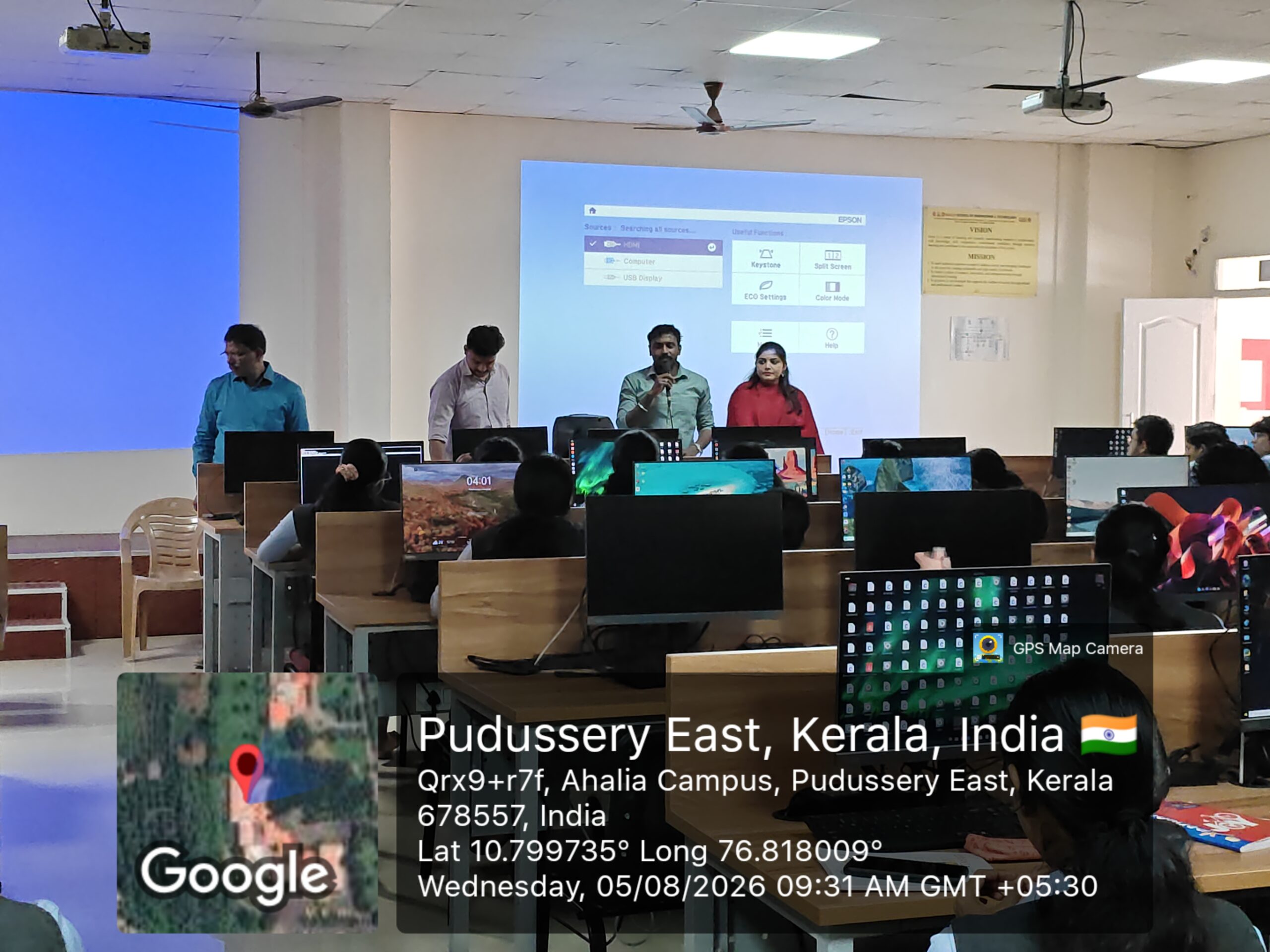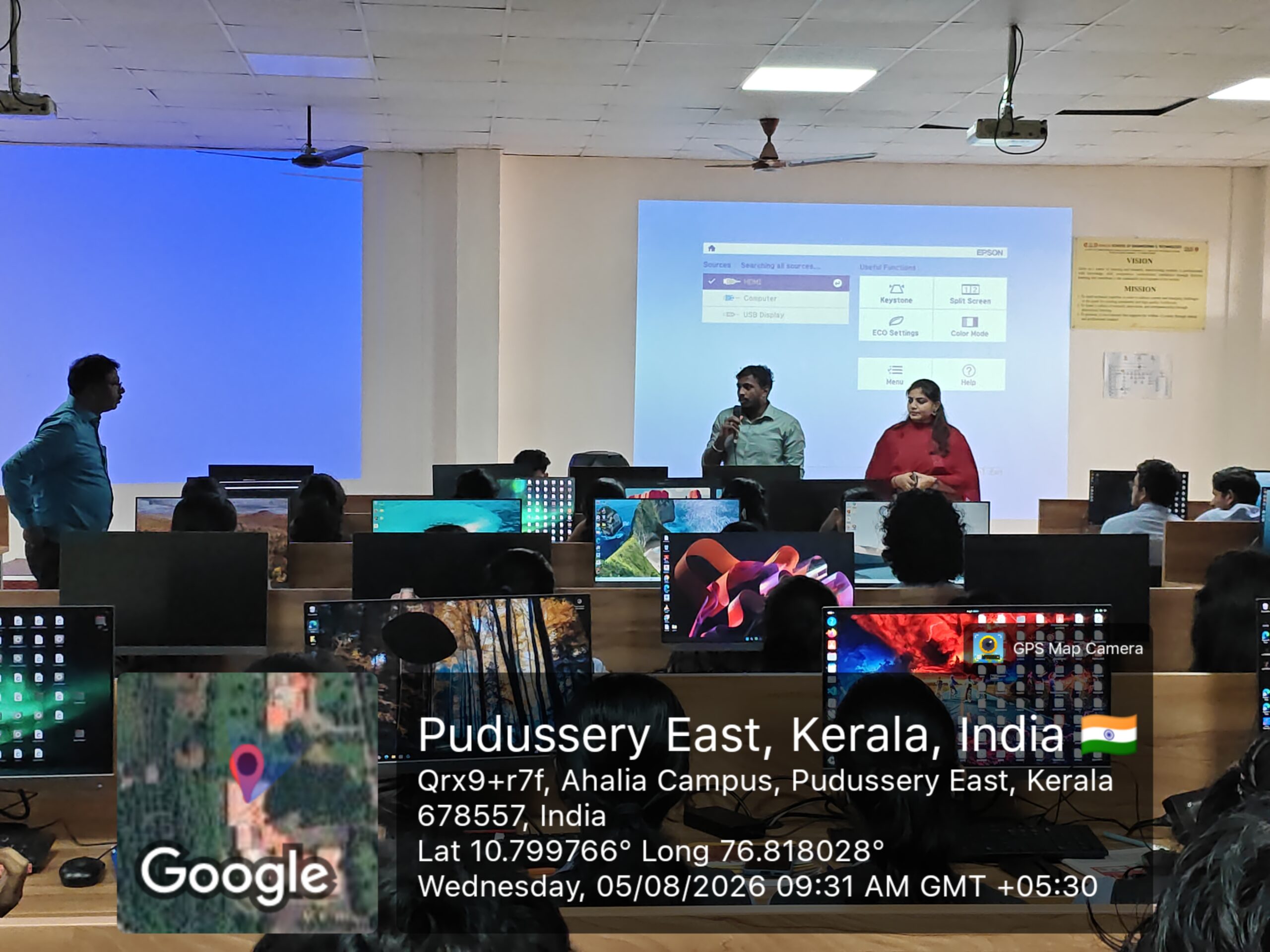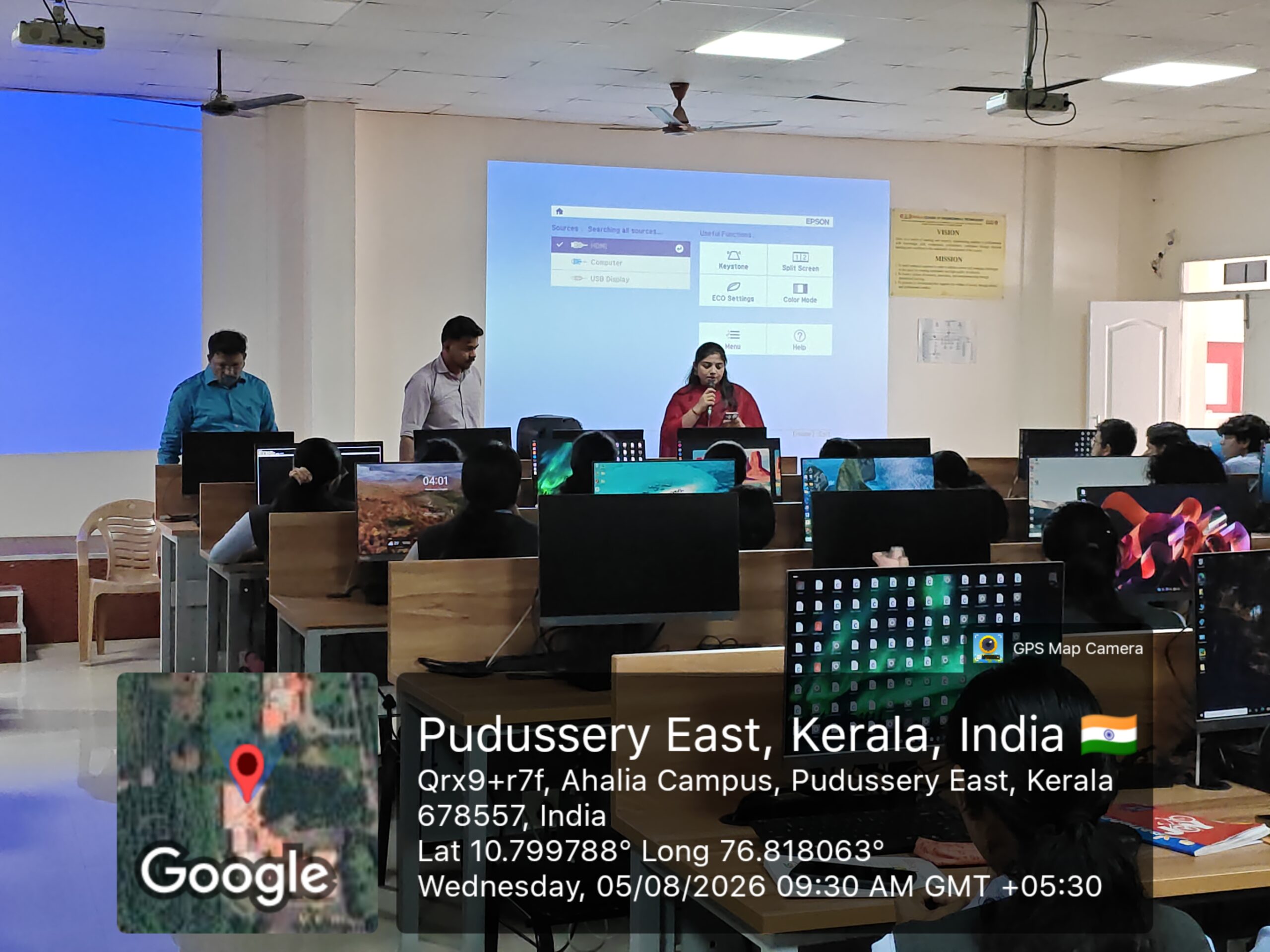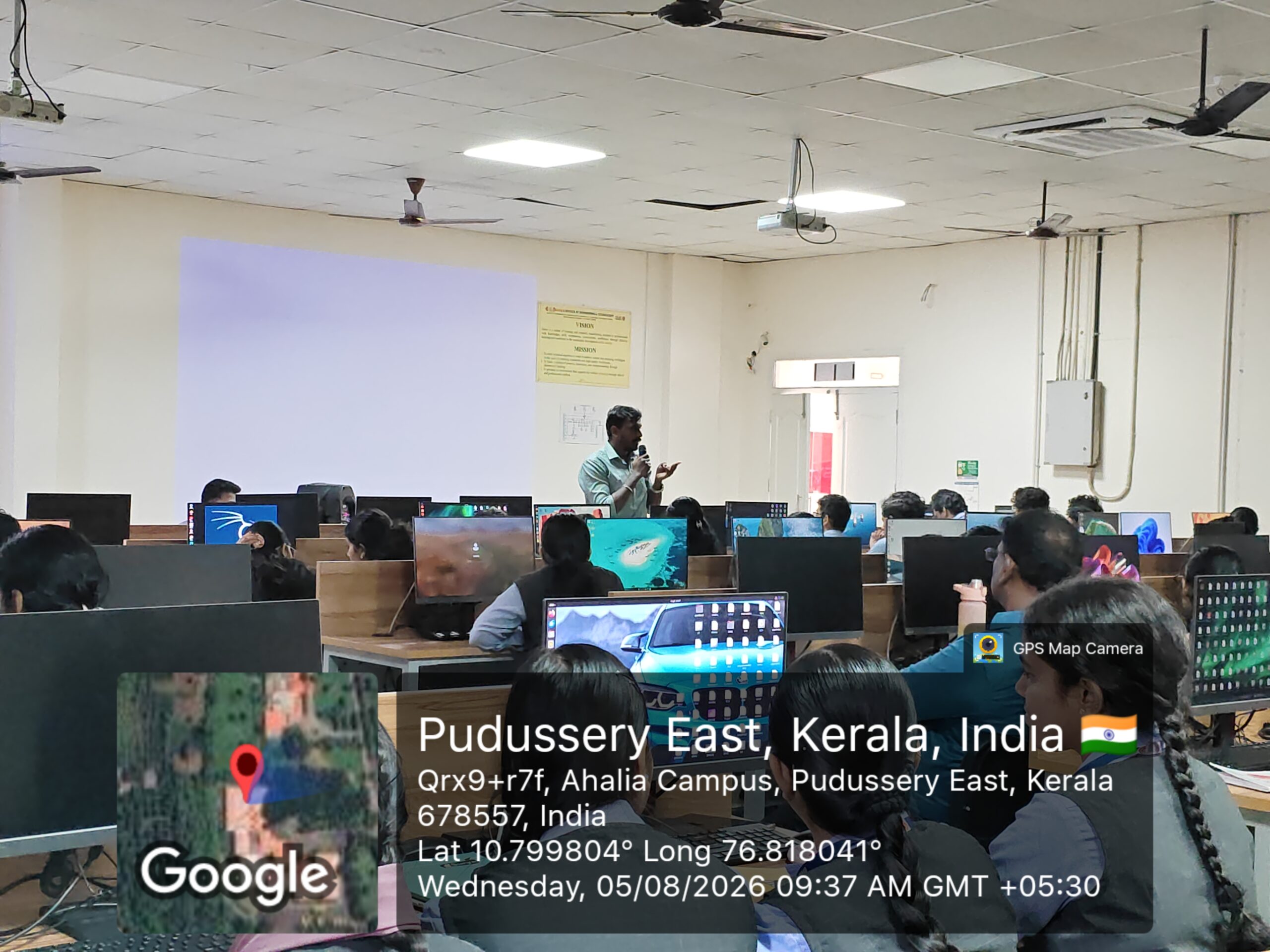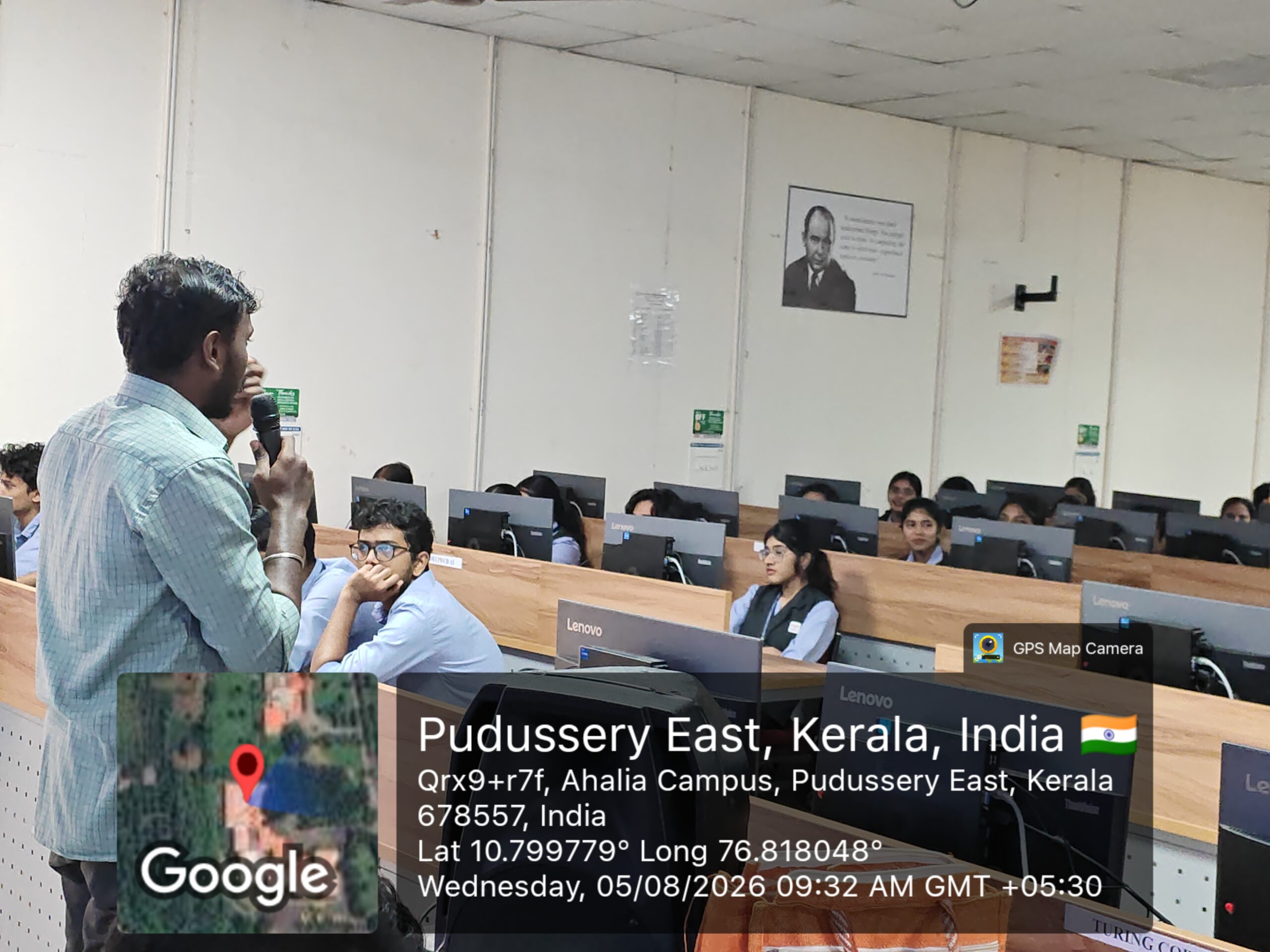
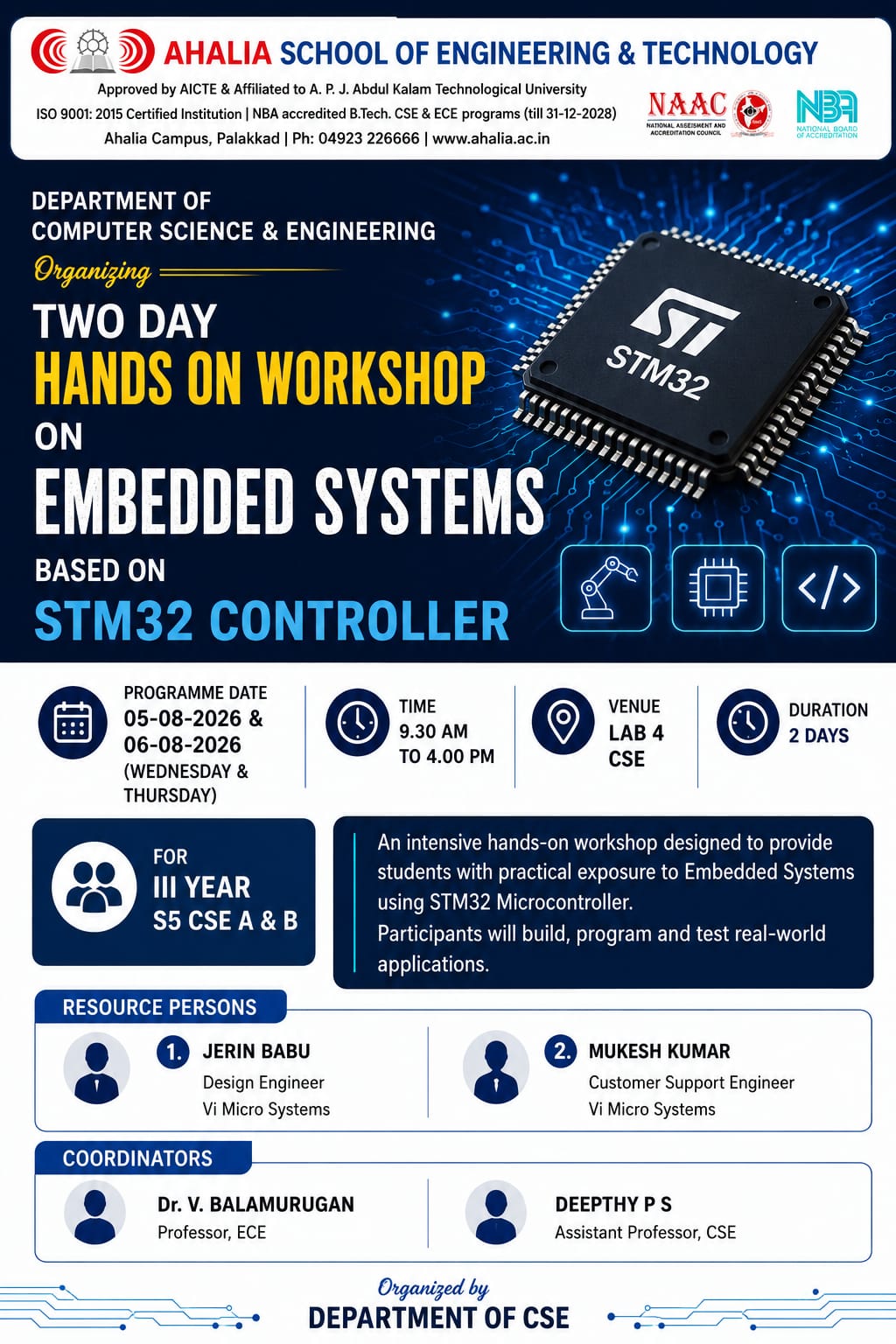

The Department of Computer Science & Engineering, Ahalia School of Engineering & Technology, successfully organized a Two-Day Hands-on Workshop on “Embedded Systems Based on STM32 Controller” on 05 August 2026 and 06 August 2026 for the students of S5 Computer Science & Engineering (Sections A & B). The workshop was conducted in CSE Lab 4 with the primary objective of providing students with practical knowledge and industry-oriented skills in embedded system design and development using the STM32 microcontroller platform.
The programme was conducted by Mr. Jerin Babu, Design Engineer, Vi Micro Systems, and Mr. Mukesh Kumar, Customer Support Engineer, Vi Micro Systems, who possess extensive industrial experience in embedded system development. The workshop began with an introduction to embedded systems, highlighting their significance in modern electronic devices, automation, robotics, automotive systems, healthcare equipment, consumer electronics, and Internet of Things (IoT) applications.
The resource persons introduced the participants to the architecture and features of the STM32 microcontroller family, explaining its advantages over conventional microcontrollers. Students were familiarized with the STM32 development environment, software installation, project creation, programming methodology, and hardware configuration. The sessions combined theoretical concepts with extensive practical demonstrations, enabling participants to understand the complete embedded system development workflow.
A major highlight of the workshop was the comprehensive hands-on training, where students programmed STM32 development boards using Embedded C. They performed practical exercises involving GPIO programming, LED interfacing, push-button control, timer configuration, peripheral interfacing, debugging techniques, and real-time application development. The workshop provided participants with an excellent opportunity to gain practical exposure to industrial development tools and debugging methodologies that are widely adopted in the embedded systems industry.
The interactive nature of the sessions encouraged students to actively participate in discussions, clarify technical doubts, and develop confidence in implementing embedded applications independently. The workshop successfully bridged the gap between theoretical classroom learning and industrial practice by exposing students to real-world embedded system design and development.
Objectives
The workshop was organized with the following objectives:
- To introduce students to the fundamentals of Embedded Systems and their industrial applications.
- To familiarize participants with the architecture, features, and programming environment of STM32 microcontrollers.
- To provide practical exposure to STM32 development boards and Embedded C programming.
- To develop the ability to configure hardware peripherals and interface external devices with microcontrollers.
- To enhance students’ understanding of GPIO programming, timers, interrupts, and peripheral communication.
- To provide hands-on experience in debugging, testing, and troubleshooting embedded applications.
- To strengthen students’ practical skills through laboratory-based learning and real-time demonstrations.
- To bridge the gap between academic curriculum and current industrial practices in embedded system development.
- To motivate students to undertake embedded systems, IoT, and automation-based academic projects.
- To improve students’ employability by exposing them to industry-standard development tools and methodologies.
Outcomes
The workshop significantly enhanced the participants’ understanding of embedded systems and STM32 microcontroller programming. Students gained comprehensive knowledge of embedded hardware architecture, software development environments, and programming methodologies used in industrial applications.
Through extensive hands-on sessions, participants acquired practical skills in configuring STM32 development boards, writing Embedded C programs, interfacing LEDs, switches, sensors, and peripheral devices, debugging embedded applications, and testing hardware modules. They also became familiar with integrated development environments (IDE), project creation, firmware uploading, and hardware troubleshooting techniques.
The workshop strengthened the students’ confidence in developing real-time embedded applications independently while improving their logical thinking, problem-solving ability, and hardware programming skills. Participants also gained valuable exposure to current industrial practices, thereby enhancing their readiness for internships, research projects, innovation activities, and future career opportunities in Embedded Systems, IoT, Robotics, Industrial Automation, and Electronics.
Feedback
The workshop received an enthusiastic response from all the participants. Students appreciated the systematic presentation of concepts, practical demonstrations, and extensive hands-on training provided by the resource persons. The interactive teaching methodology, real-time hardware implementation, and industry-oriented examples made the sessions highly engaging and effective.
Participants expressed that the workshop helped them understand concepts that are difficult to grasp through conventional classroom teaching alone. The opportunity to work directly with STM32 development boards significantly improved their practical knowledge and confidence in embedded programming. Students also appreciated the continuous support and guidance provided by the trainers throughout the laboratory sessions.
Overall, the feedback indicated that the workshop was highly informative, professionally organized, and extremely beneficial in enhancing technical competence and practical exposure to modern embedded system technologies.
Conclusion
The Two-Day Hands-on Workshop on “Embedded Systems Based on STM32 Controller” concluded successfully with the active participation of students from S5 Computer Science & Engineering (Sections A & B). The programme effectively achieved its objectives by providing an ideal combination of theoretical knowledge, practical laboratory exercises, and industry-oriented training.
The workshop enabled students to acquire valuable technical skills in embedded system programming, hardware interfacing, debugging, and application development using STM32 microcontrollers. The practical sessions strengthened their understanding of embedded technologies and encouraged them to explore advanced domains such as Internet of Things (IoT), Robotics, Industrial Automation, Smart Systems, and Edge Computing.